
News
Padel Turf Winter Installation Guide: Toshimi Sports SOP to Minimize Bulging and Seam Failure
Winter temperatures present severe challenges for Padel court artificial grass installation. In environments below 10°C (50°F), the physical properties of turf materials and the chemical reactions of installation adhesives change drastically. Failing to adapt the construction process can lead to significant post-installation maintenance issues for club owners and contractors.
The Three Core Challenges of Winter Turf Installation
●Extensive Bulging and Persistent Wrinkles: Padel turf features an exceptionally high tufting density (often exceeding 50,000 stitches/m²), creating immense internal stress from rolled packaging. Cold temperatures cause the turf backing to become rigid. If the turf is forcefully cold-stretched and installed without adequate stress release, it is highly prone to shrinkage and bulging once temperatures rise or during high-intensity play.
● Cracking and Adhesive “False Setting”: The bi-component polyurethane (PU) adhesives commonly used for court seaming are highly temperature-sensitive. In environments below 5°C (41°F), adhesive viscosity spikes rapidly, making it difficult to spread. Furthermore, the curing reaction can stall or experience a “false set.” Once the adhesive bond weakens, high-frequency player movements will quickly tear the seams apart.
● Sand Clumping and Uneven Infill: Winter weather brings high humidity and low temperatures, causing silica sand to absorb moisture and clump. Damp sand cannot successfully penetrate to the roots of high-density fibers via a power brush. This results in excess surface sand and insufficient bottom ballast, directly compromising court flatness and ball bounce performance.
Toshimi Sports Winter Construction Standard Operating Procedure (SOP)
To ensure every Padel court achieves optimal flatness even in cold climates, Toshimi Sports has established a strict winter installation protocol:
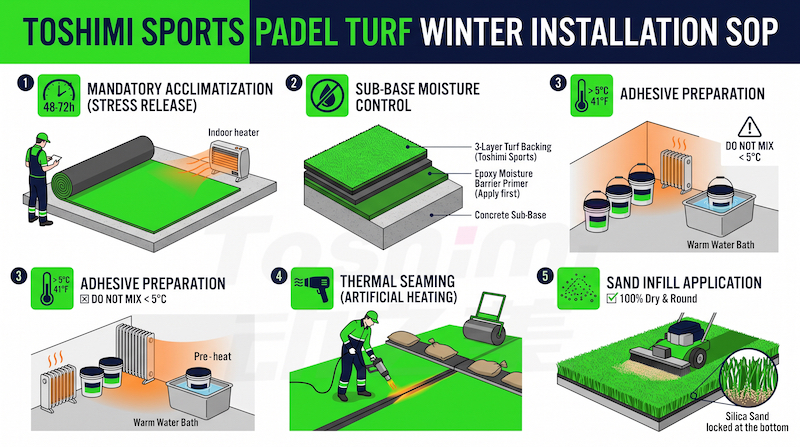
●Implement 48-72 Hours of Acclimatization: Upon arrival at the site, the artificial grass rolls must be completely unrolled and laid flat on the sub-base. The resting period should be extended from the standard 12-24 hours to 48-72 hours. For indoor facilities, turn on HVAC systems or industrial space heaters to raise the ambient temperature above 15°C (59°F), utilizing the heat to soften the backing and effectively release internal tension.
●Strictly Enforce the 5°C Adhesive Limit: Never mix or apply bi-component adhesives when ambient temperatures drop below 5°C (41°F). Before installation, store all adhesive buckets in a warm indoor environment (15°C – 25°C) for 24 hours. For outdoor sites, utilize a warm water bath to continuously pre-heat the buckets and maintain proper adhesive flowability.
●Apply Sub-Base Moisture Control: Indoor courts in winter are highly susceptible to condensation. Before laying indoor turf, it is strongly recommended to apply a professional Epoxy Moisture Barrier Primer over the concrete floor. This completely blocks rising dampness and protects the backing and seam adhesive from moisture degradation. For outdoor courts, utilize industrial blowers or flame torches to ensure the asphalt or concrete along the seam lines remains completely dry before gluing.
●Utilize Thermal Seaming with Heat Guns: Avoid using brute force to stretch cold, rigid backing edges or stubborn creases. Installers must use industrial heat guns to evenly warm along the seam lines, physically softening the backing before pressing and gluing. Once joined, continuous pressure must be applied using sandbags or heavy rollers until the adhesive fully cures.
●Execute Multi-Layer Dry Sand Application: Only 100% dry, washed, and rounded silica sand should be used. Discard the practice of dumping large volumes of sand at once. Instead, apply the sand in multiple ultra-thin layers. Immediately after spreading each layer, use a rotary power brush to force the sand deep into the base of the fibers, ensuring a uniform and heavy ballast at the bottom.
The Material Advantage: Mitigating Risk with 3-Layer Fiberglass Backing
A reliable SOP requires high-standard materials as its foundation. To control manufacturing costs, many suppliers utilize a standard “2 layers + PU/Latex” backing. Turf with this basic structure faces a significantly higher risk of shrinkage when exposed to extreme winter temperature fluctuations.
Toshimi Sports optimizes the physical engineering of its Padel turf by utilizing a reinforced Triple layers backing + Latex system. Crucially, the third layer of this backing incorporates high-strength fiberglass components. The integration of fiberglass acts as a structural skeleton for the turf, substantially enhancing dimensional stability and effectively preventing backing shrinkage. This advanced construction not only makes thermal seaming safer and more efficient during winter but also equips the court with exceptional resistance to extreme temperatures, significantly minimizing the occurrence of turf bulging.